Asia's largest Catholic nation, a Muslim south that kept Islam long before Spain arrived, and ancestral beliefs that never left — how faith shapes Filipino life.
Asia's largest Catholic nation
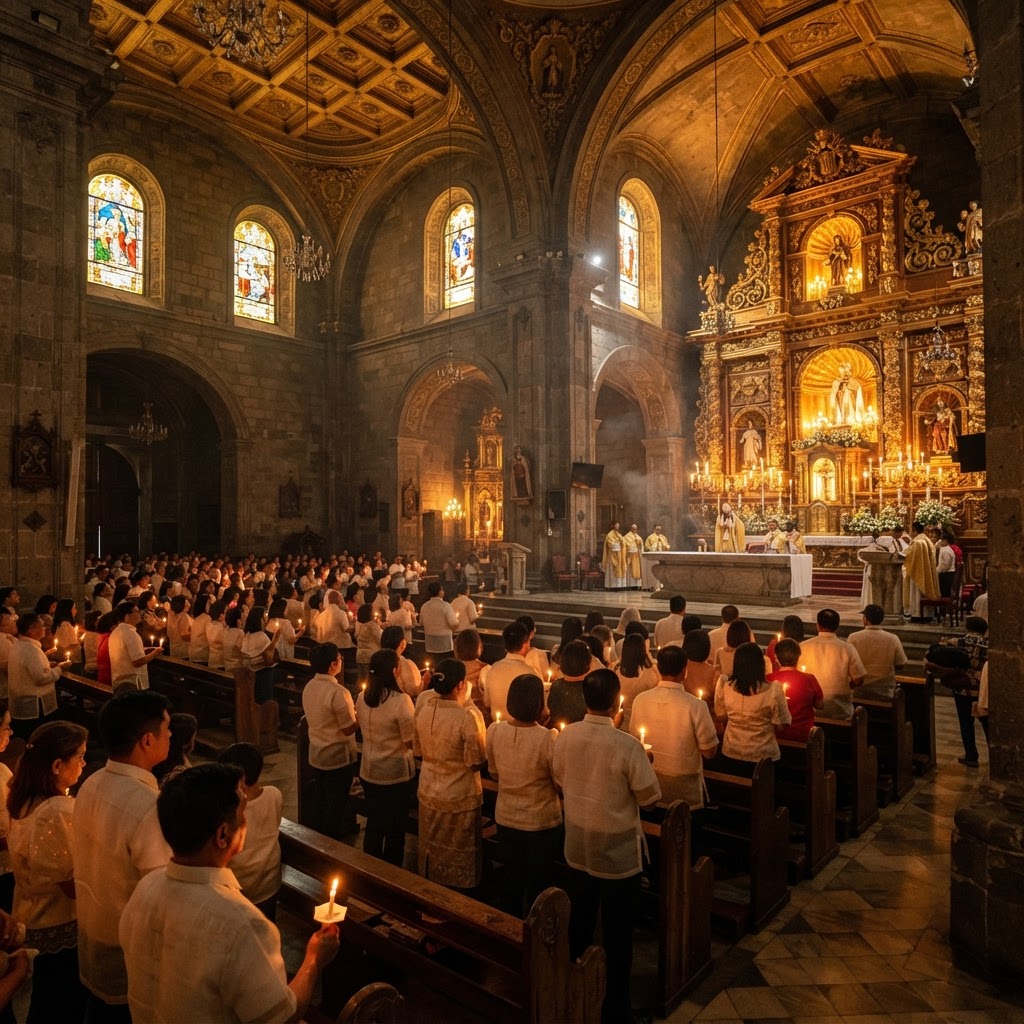
About 80% of Filipinos are Roman Catholic — the fruit of 333 years under Spain, and the reason the archipelago holds the largest Catholic population in Asia. Faith is not a weekend activity here: it sets the calendar, names the towns, and fills the jeepney windows with stickers of the Santo Niño.
The church you attend in a small town may be older than the country itself, and Simbang Gabi — nine dawn masses before Christmas — is as much community event as devotion.
Islam arrived first
A century before Magellan, Muslim traders brought Islam to the southern islands, where sultanates in Sulu and Maguindanao were already established powers when Spain sailed in. Mindanao's Muslim communities — Moro, in the old colonial vocabulary — kept their faith through centuries of pressure.
Today the south carries a distinct character: mosques beside coconut groves, kulintang gong music at weddings, and a cuisine heavy with turmeric, coconut and beef dishes rarely found up north.
Old beliefs beneath the new
Underneath the imported faiths live older ones. Highland communities keep animist traditions and nature spirits; healers and albularyos practice alongside pharmacies; anting-anting amulets still turn up at fiestas.
This is not contradiction but layering — a uniquely Filipino capacity to hold older and newer worlds at once. Ask about the spirits of Mount Banahaw or the babaylan of the Visayas and the conversation gets very long, very happily.
Festivals of faith
Faith's most visible expression is festive. The Santo Niño is honored in three great January festivals — Sinulog, Ati-Atihan, Dinagyang — each recalling the child image Magellan carried ashore. Holy Week brings penitensiya processions and, in San Pedro Cutud, men reenacting the crucifixion. May brings santacruzan pageants of flowers.
For visitors, the festivals are the easiest door into understanding: faith here is not quiet, and it is not separate from joy.