The bowing gesture that opens every Filipino home, and the language of po and opo that makes courtesy a matter of grammar, not politeness.
A gesture older than its word
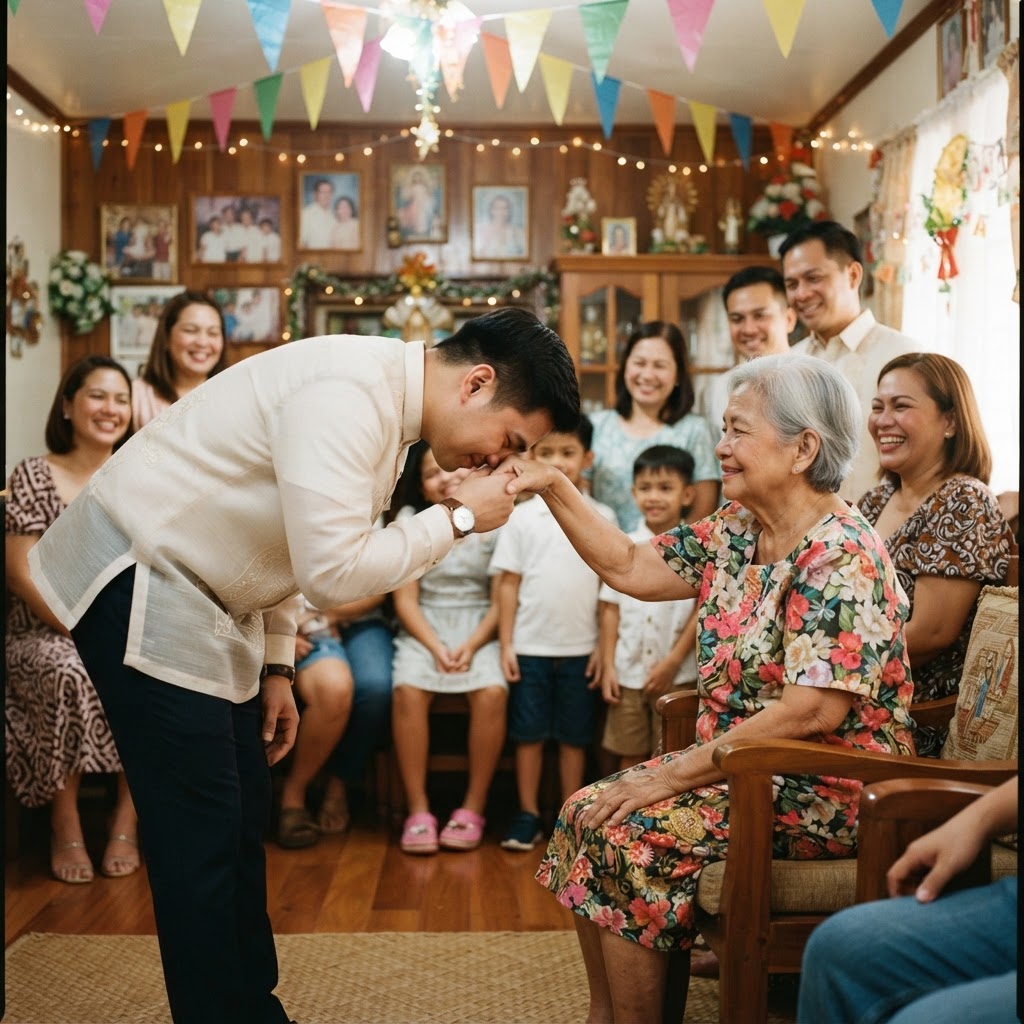
Mano po is the Filipino gesture where a young person bows, takes an elder's hand, and presses its knuckles gently to their forehead. Children are taught it before they can talk — sometimes before they fully understand it. The gesture says, without any words, that someone came before you, and that the people who raised your parents deserve honor in the body, not just in the mind.
It is learned in the smallest moments: a grandmother arriving at the house, a godparent at a birthday, a titas and titos filling a living room at Christmas. The child walks around the room, mano to each in turn, and the elders say a small blessing back — God bless you, kaaway mo ang masasama, good things be near you.
Po and opo: courtesy built into grammar
The respect gesture has a linguistic twin. Filipino, like many Philippine languages, carries politeness particles — po and opo — that have no direct English translation. Saying Magandang umaga po instead of Magandang umaga does not change the meaning of good morning. It changes its tone: it marks the speaker as raised well.
The rules are absorbed early. Po is used with elders, strangers, teachers, anyone owed deference; opo answers a question from an elder where a flat oo (yes) would sound blunt. Visitors hear it constantly — sa counter, sa jeep, sa tindahan — because courtesy here is not a choice you make. It is grammar.
Where it happens beyond the home
Mano is not confined to living rooms. It is offered at family reunions, at weddings when the couple approaches the parents of the bride and groom, and during Christmas visits when children collect blessings from each relative. OFWs do it over video calls to grandparents, hand to camera, forehead to screen — a joke, but not really.
In the provinces, a visitor introduced to a lolo or lola will often be gently prompted: Mano na kayo sa lola. The elder will usually insist it is not necessary, and everyone will watch to see if you do it anyway.
How a visitor should respond
If you are introduced to an elderly Filipino, you may offer the gesture yourself: extend your right hand, palm down, and say Mano po as you bow slightly toward it. It is not expected of foreigners, which is precisely why it lands so well.
You will rarely see a grander welcome than the one that follows it. And if mano feels like too much to start with, simply begin with po — Salamat po, Magandang araw po. It is the smallest sentence in the world that tells a family you understand something essential about theirs.